

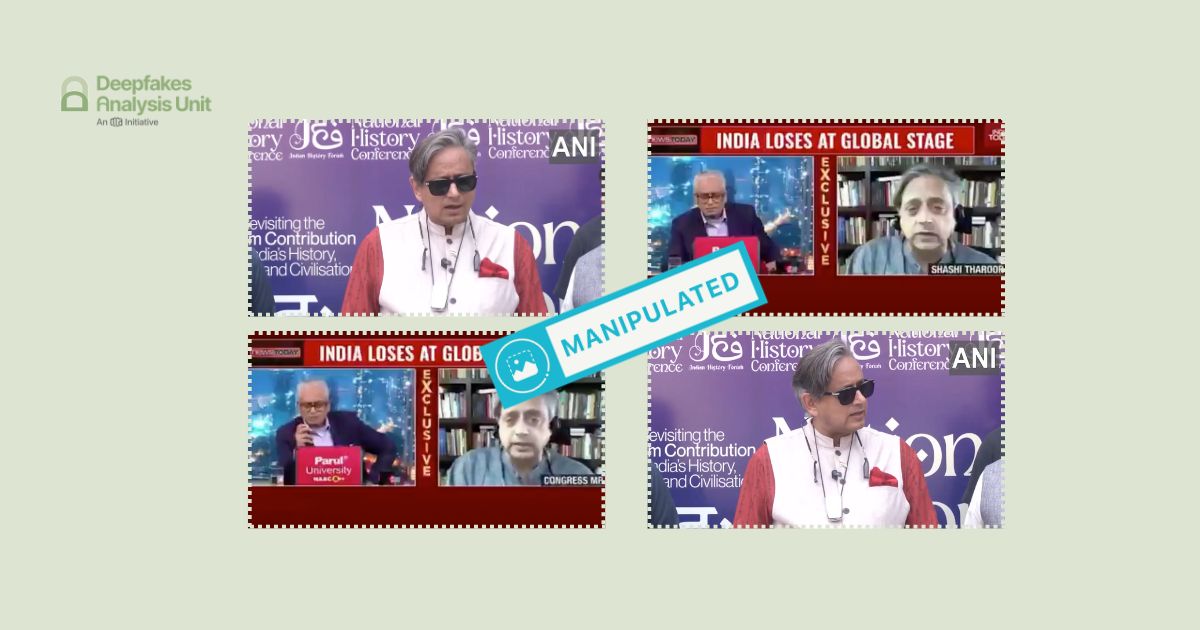
The Deepfakes Analysis Unit (DAU) analysed two videos apparently featuring Dr. Shashi Tharoor, Member of Indian Parliament and Chairperson of the Parliamentary Standing Committee on External Affairs. In one of the videos he appears with Rajdeep Sardesai, a television journalist. Both videos seem to show Dr. Tharoor lamenting over India being overshadowed by Pakistan’s diplomatic posturing as peacemaker between Iran and the U.S. After putting the videos through A.I. detection tools and getting our expert partners to weigh in, we were able to conclude that the videos were manipulated with synthetic audio.
Both the videos are in English and were discovered by the DAU during social media monitoring. The video supposedly featuring Tharoor and Mr. Sardesai spans a little over a minute; it was embedded in a post on X, formerly Twitter. The other video purportedly featuring only Tharoor is 40-seconds long and was posted on Facebook.
The X post was shared by an account with the display name of “A.K Mohsin” and a display picture of a man. The profile details suggest that the handle belongs to a “journalist” and mentions Pakistan as the location. The text with that video in English, read: “Shashi Tharoor throws Modi۔۔(sic) Very well said by Shashi Tharoor that Pakistan emerged as global net security provider while Indians are busy in Bollywood fantasies like Dhurandar 2. @all”.
The Facebook account which posted the other video goes by the display name of “Hasnain Nangyal” and a display picture of a man. The profile details suggest that the account belongs to a “digital creator” based in Mansehra, a city in Pakistan. The text with the video in English, read: “Delhi | On Pakistan mediating US-Iran negotiations, Congress MP Shashi Tharoor says, ‘You know I have always spoken about the colonization(sic) of India by the West. But what I am seeing today is a complete colonization(sic) of Indian diplomacy, again at the hands of Pakistan. I mean, it is such a sad spectacle to see Steve Witkoff and JD Vance right there in Islamabad’."
We do not have any evidence to suggest whether the suspicious videos originated from any account on X, Facebook, or elsewhere. The Delhi High Court recently granted relief to Tharoor who had sought protection against the misuse of his personality rights.
The purported video of Tharoor and Sardesai opens with a split screen with two distinct video streams playing simultaneously. Both men are captured in a medium close-up looking into the camera. Sardesai, seen on the left, appears seated in a studio-like setting with a skyline in the backdrop. Tharoor, seen to the right, seems to be in a study or office setting as books on shelves are visible behind him. A voice track can only be heard with Tharoor’s video stream, Sardesai does not appear to talk at all.
The two screens are separated by a vertical red bar carrying an arrangement of the word “exclusive” in bold. A static white text graphic, also in bold, set against a red background appears at the top of the screen, and reads: “India loses at global stage”. The top-right corner of the video frame features a logo resembling that of India Today, an English news channel in India; and the top-left corner displays the word arrangement: “news today”, with the first word in white and the other in black.
A laptop with a red sticker bearing the words “Parul University NAACA++” on its lid, a glass of water, and a mug are seen in front of Sardesai. On Tharoor’s screen text graphics alternate between displaying his full name and “Congress MP”, referring to his political party affiliation.
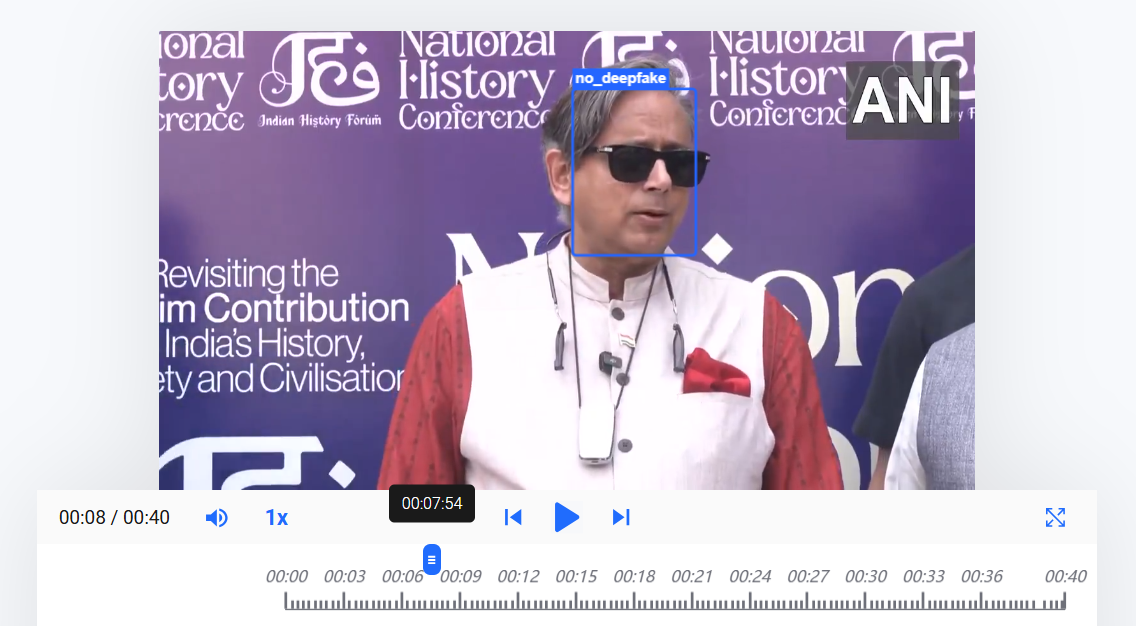
In the other video, purportedly featuring only Tharoor, he has been captured in a medium close-up. He seems to be standing, surrounded by some people who are not fully visible in the frame though. As he appears to talk his head moves in different directions, making it seem that he is addressing an audience. His backdrop comprises a purple board with text in white which mentions “National History Conference” multiple times with some other details, which are not captured properly in the video. A logo resembling that of ANI, an Indian news agency, is visible in the top right corner of the video frame.
The video quality of both videos differs. The one purportedly featuring Tharoor is good quality but the other one supposedly featuring Tharoor and Sardesai is rather poor quality and heavily compressed. However, Tharoor’s lip movements sync well with the accompanying audio track in both the videos. In the video that purportedly features him alone, his teeth seem to disappear and reappear between frames and also appear jagged in some frames; and the area from his chin down to his throat appears blurry in other frames.
We compared the voice attributed to Tharoor in the two videos, with his recorded speeches and interviews available online. There is striking similarity with his voice, tone, and accent. However, the intonation and the pace of his speech—which is slower and measured—do not match with the voice tracks in the videos which sound rather flat and scripted. A slight echo and background music accompanies the audio track in the video that supposedly features him and Sardesai.
We undertook a reverse image search using screenshots from the two videos. Tharoor’s and Sardesai’s visuals were traced to this video published from the official YouTube channel of India Today on Dec. 26, 2025. The clip used in the video apparently featuring only Tharoor was traced to this video, published from the official X account of ANI on April 11, 2026.
The clothing, backdrop, and body language of Tharoor and Sardesai in the videos we reviewed and the ones we traced are identical. Tharoor speaks in English in the video with Sardesai, however in the video that features only him, he speaks in Hindi. The content of the speech is different in the videos we reviewed—which are in English—and the ones we traced.
The source video of Tharoor and Sardesai has a logo of India Today, “news today”, and text graphics. The positioning of these elements is identical in the doctored video but for the text graphics at the top, which are different and keep changing, and a thumbnail image of the India Today logo in the bottom right corner, which is not part of the doctored video. The foreground is also identical between the two videos though the source video quality is good with no echo or background music as audible in the doctored video.
The other video, which features only Tharoor, has an ANI logo—the exact same one seen in the doctored video and at the same position. The video quality is good with no blurriness visible around Tharoor’s neck region as is the case in doctored video.
It appears that a clip each has been lifted from the source videos to create the respective doctored videos.
Shared below is a table that compares the transcripts of the audio tracks from the doctored videos. We want to give our readers a sense of how the audio tracks are being used to peddle a certain narrative. We, of course, do not intend to give any oxygen to the bad actors behind this content.

To discern the extent of A.I. manipulation in the videos we reviewed, we put them through A.I. detection tools.
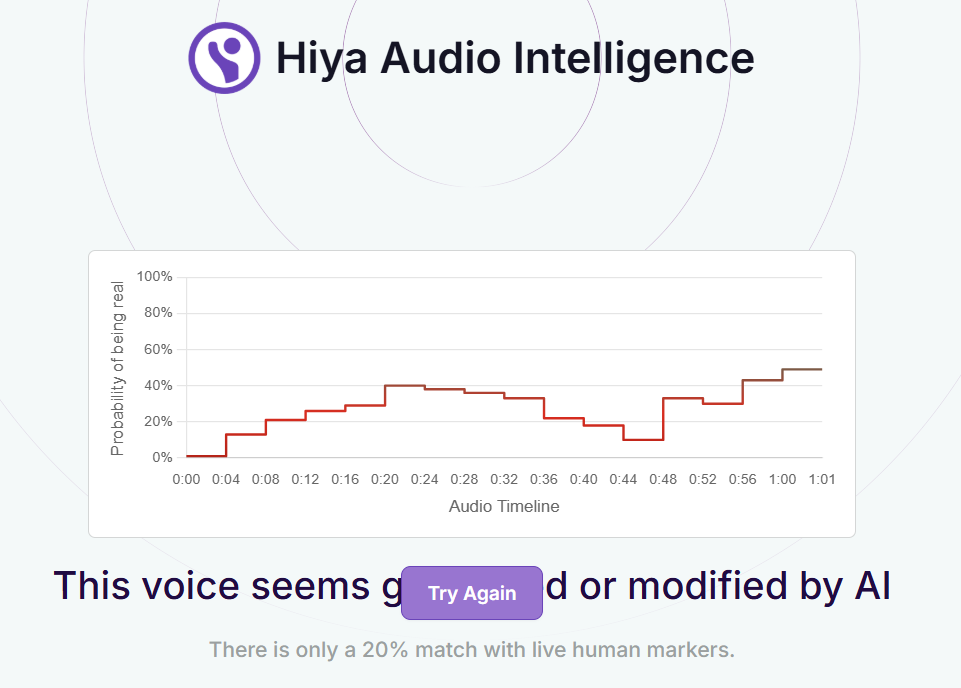
The voice tool of Hiya, a company that specialises in artificial intelligence solutions for voice safety, indicated that there is an 80 percent probability that the audio in the video track purportedly featuring Tharoor and Sardesai, was modified or generated using A.I. For the other video supposedly featuring only Tharoor, the tool gave a 99 percent probability for the audio having been modified or generated using A.I.

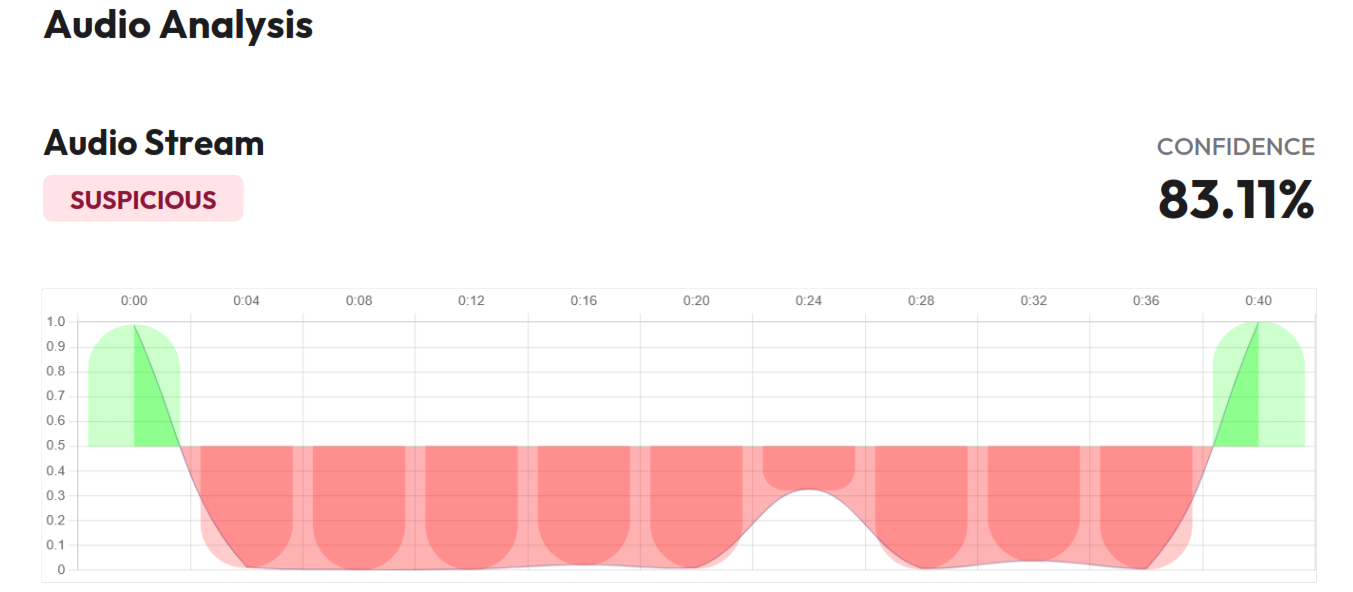
Hive AI’s deepfake video detection tool highlighted a few markers of A.I. manipulation in the doctored video featuring Tharoor and Sardesai but none in the video that purportedly features Tharoor. Their audio detection tool highlighted a 20-second segment as “A.I.-generated” in the audio track of the doctored video of Sardesai and Tharoor and a 30-second segment as “A.I.-generated” in the other video.

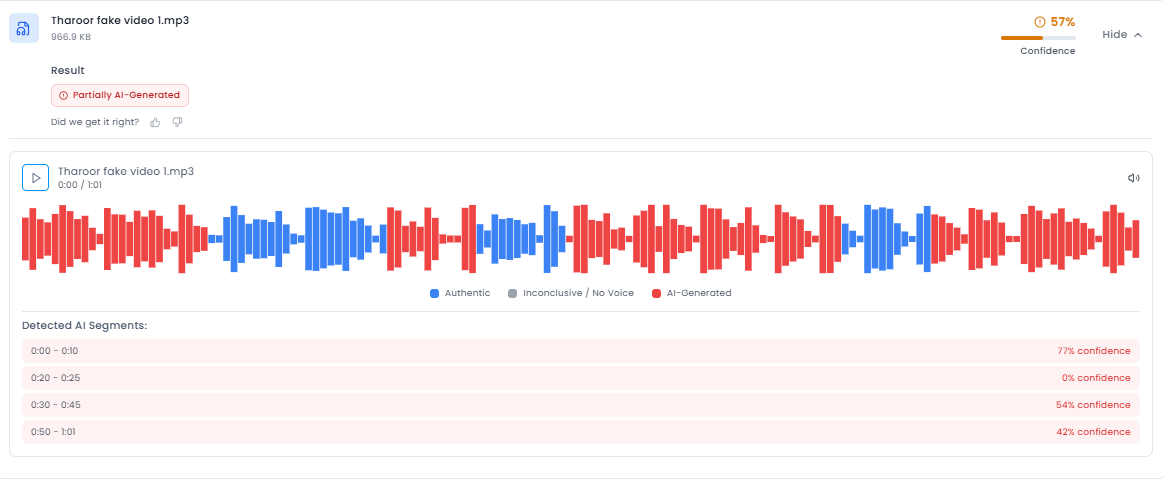
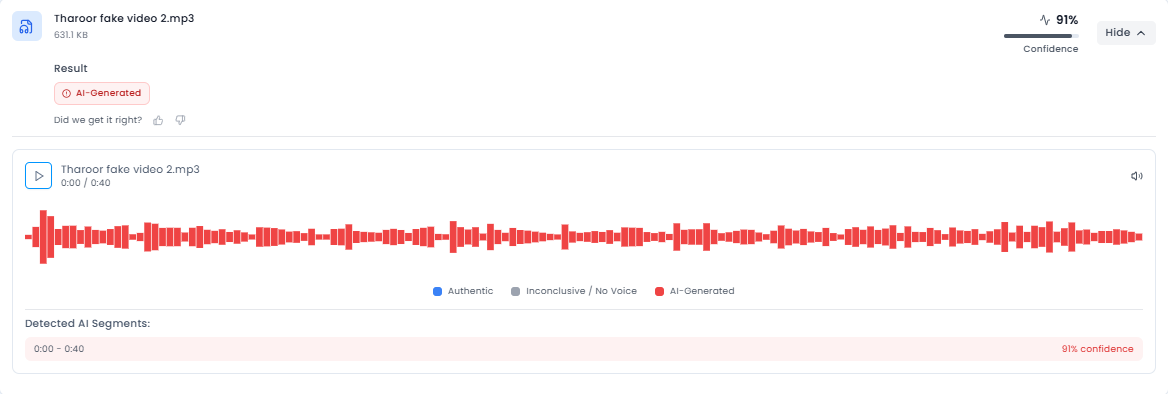
We ran the audio tracks from the videos through the advanced audio deepfake detection engine of Aurigin.ai, a Swiss deeptech company. The results indicated 57 percent confidence in the purported audio of Tharoor being partially A.I.-generated in the video featuring him and Sardesai; and 91 percent confidence in the supposed audio of Tharoor being A.I.-generated in the other video.
We also put the audio tracks through the A.I. speech classifier of ElevenLabs, a company specialising in voice A.I. research and deployment. The results that returned indicated that it was “very unlikely” that the purported voice of Tharoor in the video featuring him and Sardesai was generated using their platform; and the audio track in the other video was “very likely” generated using their platform.
A further analysis by the team established that both the audio tracks attributed to Tharoor are synthetic or A.I.-generated.
To get an analysis on the videos we reached out to Contrails AI, a Bangalore-based startup with its own A.I. tools for detection of audio and visual spoofs. The team ran the videos through audio and video detection models.
The results that returned indicated A.I.-manipulation in the video track and the audio track of both the videos. However, the team noted low confidence in the results for the doctored video of Tharoor and Sardesai; and high confidence in the results for the doctored video that features only Tharoor.
The team explained that the low confidence score is due to the low quality of the doctored video of Tharoor and Sardesai. They noted that the video has been heavily pixellated, resulting in significantly degraded visual quality. They added that a lip-sync technique may have been used to manipulate pixels to synchronise visuals with the audio clip.
They also stated that voice cloning techniques may have been used in the video though there is a certain graininess in the audio quality; and the monotonous nature of the voice indicates A.I.-manipulation.
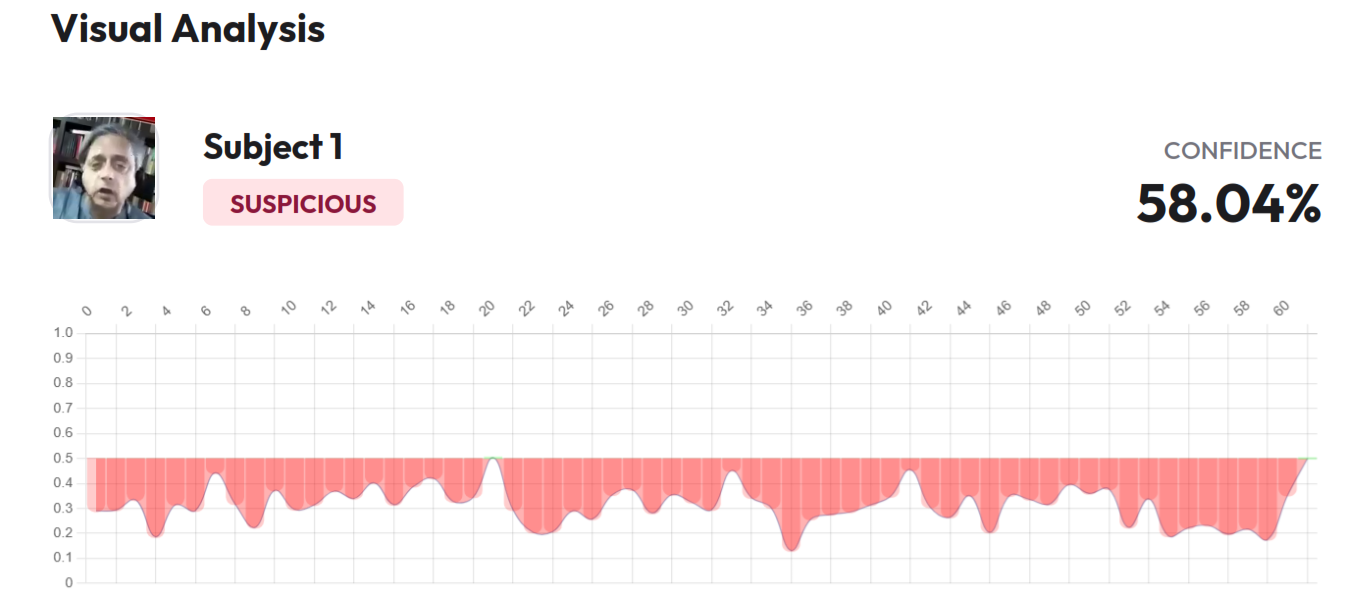
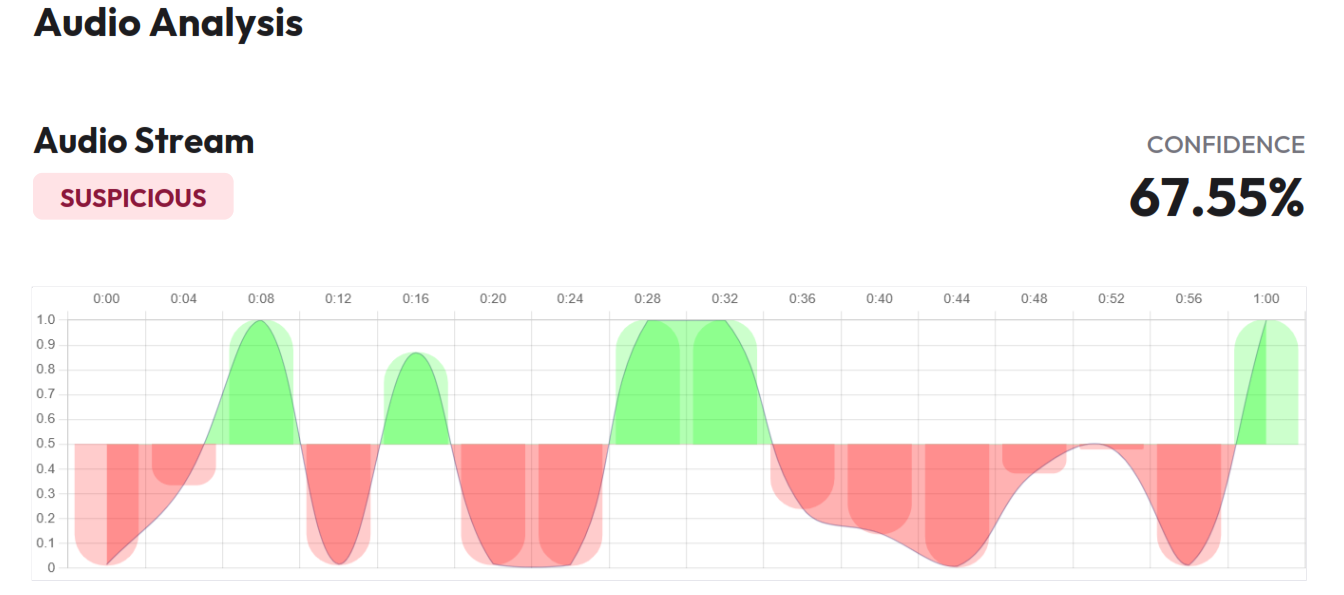
For the doctored video of Tharoor, as well, the team noted the use of a lip-sync technique to manipulate pixels to synchronise visuals with the audio clip. They detected clear signs of the use of voice cloning techniques in the audio. They added that the monotonous nature of the speech validates this further especially in the second half of the video.
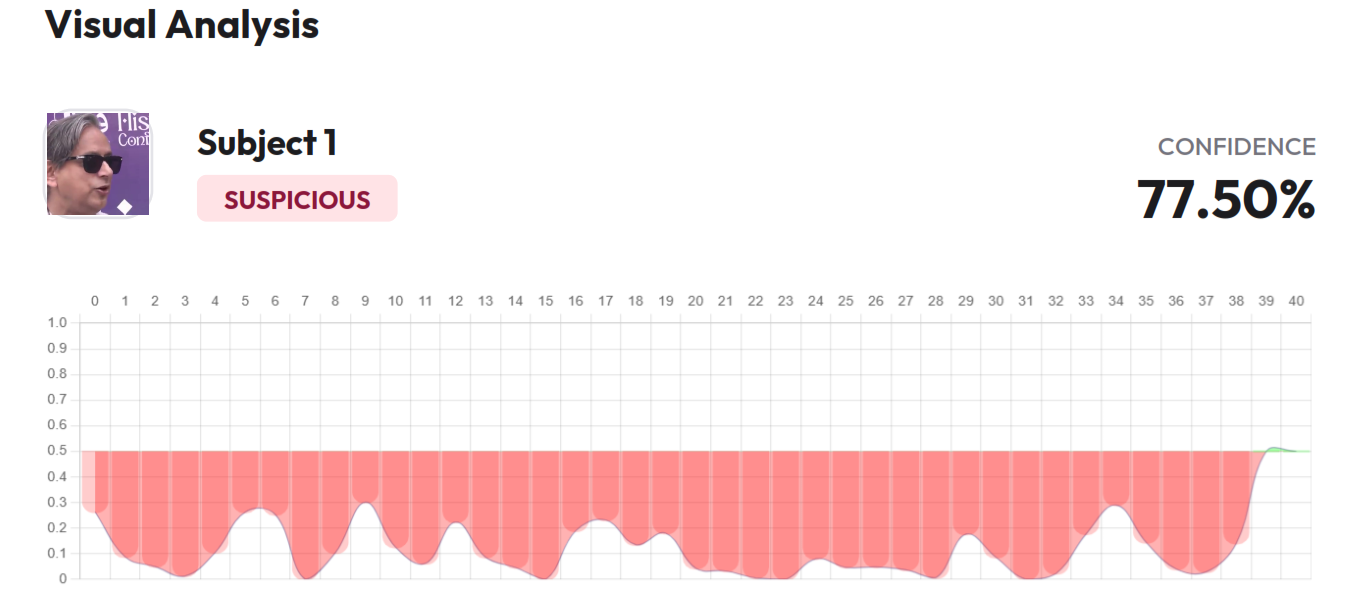
To get expert analysis on the doctored video of Tharoor and Sardesai, we reached out to our partners at RIT’s DeFake Project. Saniat Sohrawardi from the project noted that limited information can be gathered from the video given its extremely low-quality.
Mr. Sohrawardi pointed out that the video has issues that are often true of a lot of fake speech videos. He explained that the speaker is too composed, there is absence of any filler words such as “ums” or pauses in speech, which sounds fairly monotone.
The team traced the same source video that we have linked to above. Sohrawardi compared the body movements of the subjects in the two videos, and traced a clip from the source video which matched with the one used in the doctored video. He explained that this is a lip-sync deepfake, likely created using wav2lip— a speech-to-lip generation code repository available online for video generation. His analysis was based on the observation that the movements of subjects stayed the same while the speech and lips were changed.
He further added that the quality of the video also suggests that an older algorithm was likely used to create the video, which was heavily compressed to avoid the visible artifacts around the mouth. He noted that because of this it is harder to attribute a lot of the visible blocking or misalignment artefacts to lip-sync issues as those could also be present due to heavy video compression.
To get further analysis on the doctored video of Tharoor, we escalated it to Global Online Deepfake Detection System (GODDS), a detection system set up by Northwestern University’s Security & AI Lab (NSAIL). The video was analysed by two human analysts, run through 22 deepfake detection algorithms for video analysis, and 70 deepfake detection algorithms for audio analysis.
Of the 22 models, six gave a higher probability of the video being fake and the remaining 16 gave a lower probability of the video being fake. Of the 70 predictive models, 63 gave a higher probability of the audio being fake, while the remaining seven gave a lower probability of the audio being fake.
In their report, the team pointed to several time codes where as the subject appears to speak his teeth seem to change shape and often appear blurry. They also highlighted another set of time codes where the subject's neck seems to overlap with his lanyard, appearing unnatural.
The team stated that throughout the video, the subject’s jaw seems to move in an exaggerated manner, almost appearing puppet-like. They further added that hair visible around his neck appears blurred despite most of it appearing naturally detailed. They observed that the subject’s voice lacked natural tonal and cadence variations characteristic of human voices. In conclusion, the team stated that the video is likely manipulated via artificial intelligence.
On the basis of our observations and expert analyses, we can conclude that in both the videos original footage was used with synthetic audio, to peddle a false narrative about Tharoor lamenting India’s failure as Pakistan played negotiator between Iran and the U.S. in the West Asia conflict.
(Written by Debopriya Bhattacharya and Debraj Sarkar, edited by Pamposh Raina.)
Kindly Note: The manipulated audio/video files that we receive on our tipline are not embedded in our assessment reports because we do not intend to contribute to their virality.
You can read the fact-checks related to this piece published by our partners:
Video Of Shashi Tharoor Criticising India’s US-Iran War Strategy Is Deepfake
Fact-Check: Video of Shashi Tharoor Praising Pakistan’s Diplomacy Is a Deepfake
Fact Check: Shashi Tharoor lauded Pak for mediating US-Iran war? Video is deepfake
Viral Video Showing Shashi Tharoor Praising Pakistan’s Diplomacy Is Doctored


.png)