

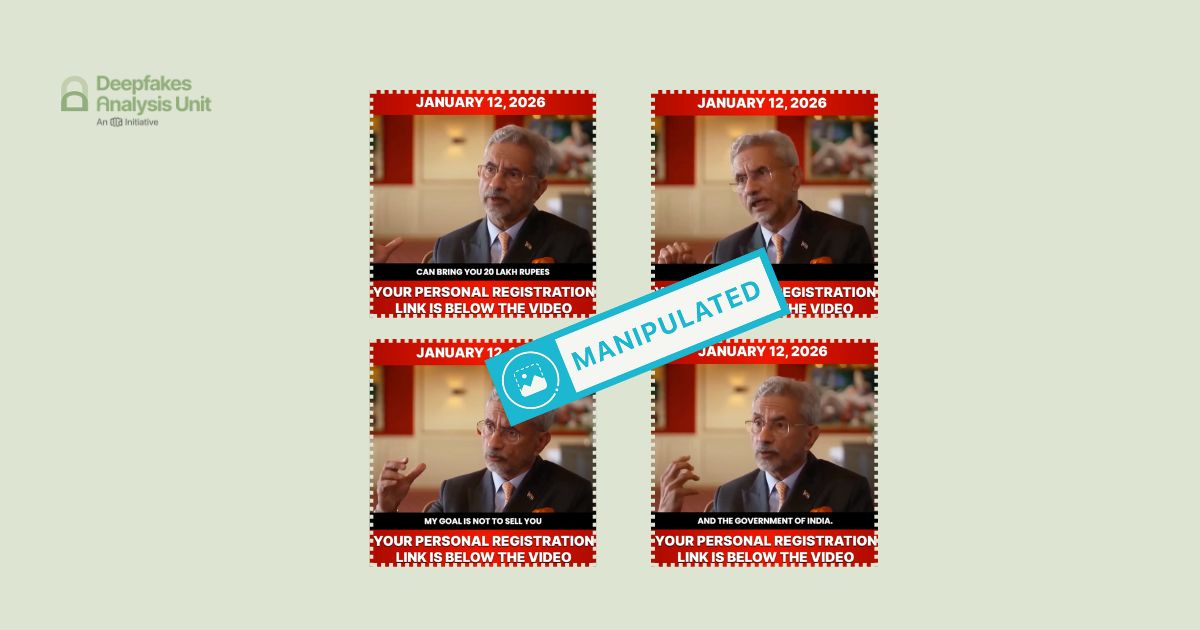
The Deepfakes Analysis Unit (DAU) analysed a video that shows Dr. Subrahmanyam Jaishankar, India’s External Affairs Minister, apparently endorsing a financial investment platform supposedly backed by the Indian government and the Reserve Bank of India (RBI). After putting the video through A.I.-detection tools and getting our expert partners to weigh in, we were able to conclude that the video was fabricated using an A.I.-generated audio track.
The four-minute-and-11-second video in English was discovered by the DAU during social media monitoring. It was embedded in a post on Facebook. However, the post is not available anymore on the link we traced; and we were unable to capture the details of the account that posted it. We do not have any evidence to suggest whether the suspicious video originated from an account on Facebook or elsewhere.
Dr. Jaishankar is captured in a medium close-up in the video. He appears to be seated on a chair, apparently speaking to someone in front of him as his gaze and head are positioned at a specific angle while his hands move in an animated manner throughout. His backdrop seems a bit blurred, seemingly a wall behind him bears red and white colors with some framed painting fixed on it.
Captions in English visible below the video frame relay the transcript of the audio content throughout. Bold text graphics in white set against a red background visible at the top of the video frame read: “January 12, 2026”; those at the bottom, also set in the same color and background, visible below the captions read: “your personal registration link is below the video.” During the last six seconds of the video bold text graphics also in white, set against a visual of the fluttering Indian flag, read: “follow the link to learn more”; multiple arrows pointing downward follow the text.
A male voice recorded in first person over Jaishankar’s video track asks viewers to watch the video “till the end” if they are watching the video on “Monday, January 12th”, as it could become a “turning point” in their lives. The voice claims that “simply watching the video” can help anyone earn “20 lakh rupees in just one month”. It asserts that the “message was not sent by a scammer” but by “Subrahmanyam Jaishankar, Minister of External Affairs of India”. The voice adds that it “respects” the viewers and doesn’t “make empty promises like many others”, and that it doesn’t want anything from them, but for their “trust”.
The voice assures that the viewers could “begin earning 80,000 rupees per day”, which would be “more than 5 lakh rupees per week”. It further guarantees that these are not “one-time payouts” but “stable income” that would be deposited into their account “every month”. It also claims that Jaishankar supposedly tried the platform with a deposit of “22,000 rupees” and the balance in his purported “account” stands at “44 lakh rupees” now. It adds that the platform has “no risk, no hidden conditions”, is a “fully automatic” and “reliable and legal source of income”.
A sense of urgency is created by the voice about the get-rich-quick platform, as it announces that viewers should not “miss this chance” as “there will not be another one”. It further claims that the “goal” is to “help as many Indians as possible earn through this system” and that the supposed “partner” of the person behind the voice is a “former World Bank Director”, who knows how to “generate profit even during crises”.
The voice states that the purported “partner” tested the supposed “Quantum AI platform” on a “small group of people” and each of them “earned more than 6 lakh rupees in the first week”. It boasts that there is no "dissatisfied user of this project”, and “not a single user lost money” and that their average profit reached “22 lakh rupees” in six months. And it further notes that “most users are senior citizens” and there is no “special knowledge or experience” required to use the platform.
The voice assures that it is an “official platform supported by the Reserve Bank of India and the Government of India”. It pushes viewers to watch the video till the end and directs them to register using the supposed “official website” linked “below the video”. However, no such link is visible. The video ends with the promise that the platform will solve their “financial problems much faster” and let them live the life they have “dreamed about” and that “opportunities like this appear once in 10 years.”
The overall video quality is good. The lip movements of the purported speaker synchronise well with the audio track for the most part. However, in some instances the subject’s mouth seems to move unnaturally fast; the mouth movements appear puppet-like. His lower set of teeth seem to disappear in some frames and in other frames they appear like a white patch, lacking definition.
The voice attributed to Jaishankar in the video sounds similar to his voice, as heard in his recorded interviews and speeches available online. The pitch, tone, and pauses also match, however, the accent sounds a little western and the speech seems a bit hurried compared to his characteristic delivery.
We undertook a reverse image search using screenshots from the video and traced Jaishankar’s visuals to this video published on June 13, 2025 from the official YouTube channel of the Embassy of India in the Netherlands. His clothing and body language are identical in the two videos; the backdrop is similar but not identical as cropped frames seem to have been used in the video we reviewed. The audio in both videos is in English, but the content is different.
In the source video, the logo of NOS, a Dutch news organisation, appears in the top-left corner of the video frame; and the logo of Netherlands’ public broadcasting system, NPO, is visible in the top-right corner of the frame. Captions in Dutch are also superimposed on the video, which are not part of the doctored video, as is the case with the logos.
A lapel microphone clipped to Jaishankar’s coat is clearly visible in the source video, which also has an expansive background, featuring wooden furniture, paintings, and a carpet behind him. None of these elements appear in the doctored video nor does the interviewer who features prominently in the source video but never with Jaishankar in the same frame.
It appears that more than one clip has been lifted from the source video, stitched together and used with an unrelated audio track to produce the manipulated video. Despite that the video seems fairly seamless without any obvious jump cuts or transitions.
Jaishankar has been targeted through financial scam videos previously as well. The DAU has debunked several such A.I. manipulated videos that link public officials or business leaders with dubious investment platforms that push for initial investments of 22,000 rupees or 21,000 rupees.
To discern the extent of A.I. manipulation in the video we reviewed, we put it through A.I. detection tools.
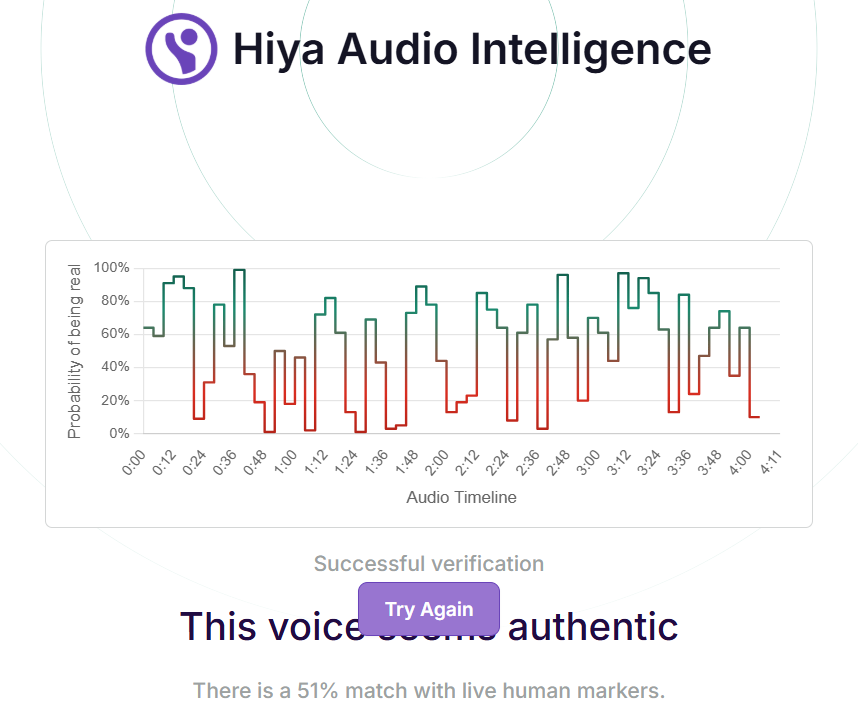
The voice tool of Hiya, a company that specialises in artificial intelligence solutions for voice safety, indicated that there is a 49 percent probability that the audio track in the video was generated or modified using A.I.
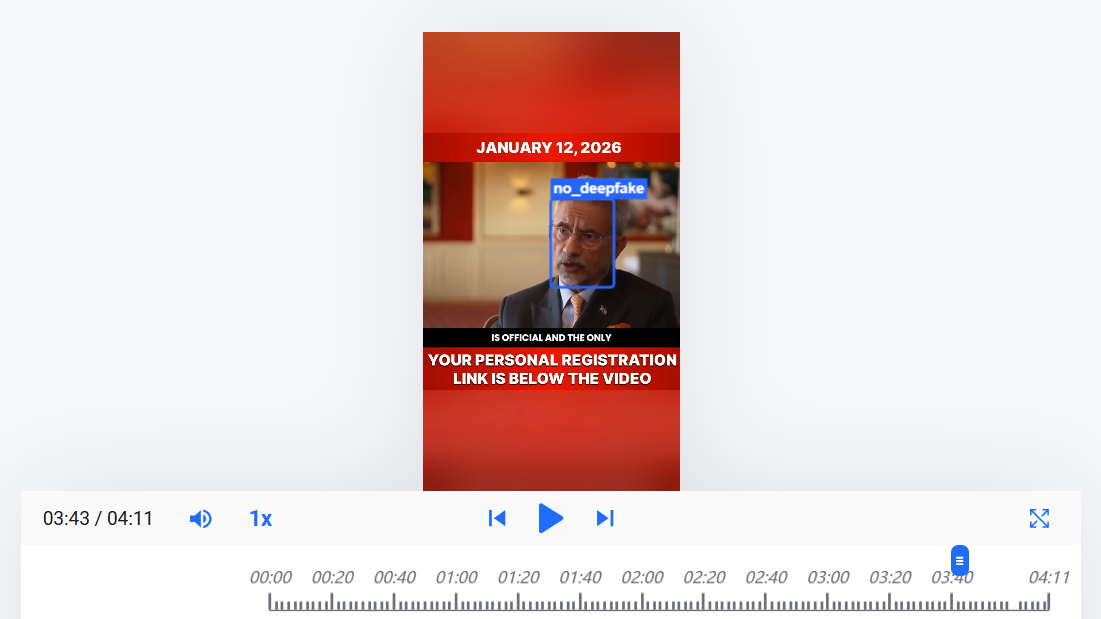
Hive AI’s deepfake video detection tool did not highlight any markers of A.I. manipulation in the video track. However, their audio detection tool indicated that 80 seconds of the entire audio track is “A.I.-generated”.
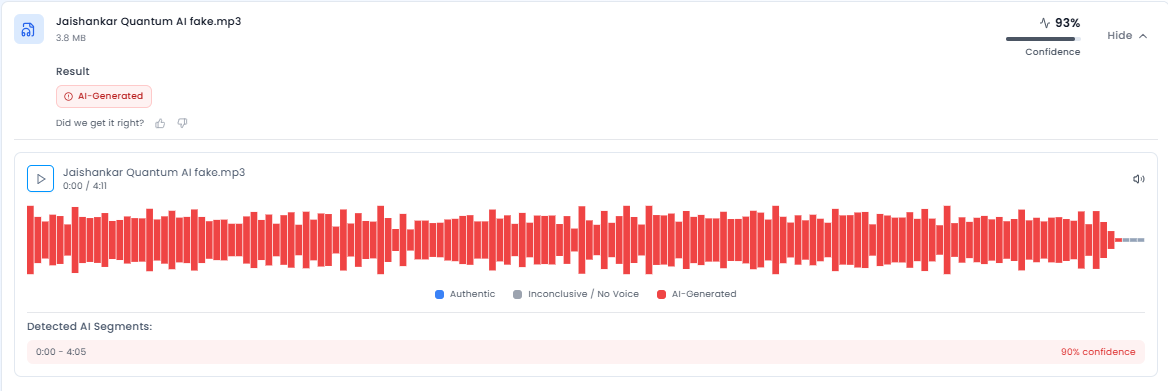
We ran the audio track through the advanced audio deepfake detection engine of Aurigin.ai, a Swiss deeptech company. The results indicated 93 percent confidence in the audio track being A.I.-generated.
We also put the audio track through the A.I. speech classifier of ElevenLabs, a company specialising in voice A.I. research and deployment. The results that returned indicated that it is “very unlikely” that the audio track used in the video was generated using their platform. However, a further analysis by the team established that the audio track is synthetic or A.I.-generated.
To get an analysis on the video we reached out to Contrails AI, a Banglalore-based startup with its own A.I. tools for detection of audio and video spoofs. The team ran the video through audio and video detection models. The results that returned indicated A.I. manipulation in the video track and the audio track.
They stated that a lip-sync technique seems to have been used to manipulate the subject’s mouth region and synchronise it with the audio track. They added that their audio spoof detection model detected signs of A.I.-generation via voice cloning in the audio track but with very low confidence. However, they observed that the audio also sounds highly monotonous, which is a sign of A.I. usage.
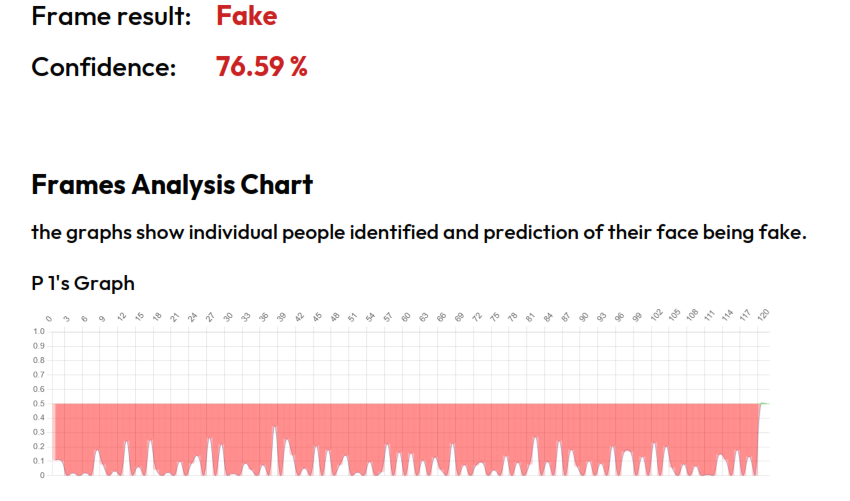
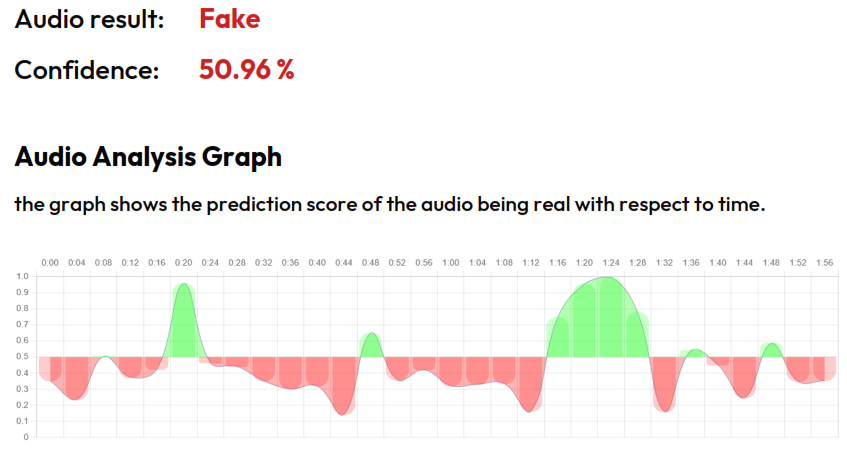
To get further expert analysis on the video, we escalated it to the Global Online Deepfake Detection System (GODDS), a detection system set up by Northwestern University’s Security & AI Lab (NSAIL). The video was analysed by two human analysts, run through 22 deepfake detection algorithms for video analysis, and 70 deepfake detection algorithms for audio analysis.
Of the 22 predictive models, nine gave a higher probability of the video being fake and the remaining 13 gave a lower probability of the video being fake. Of the 70 predictive models, 11 gave a higher probability of the audio being fake, while the remaining 59 gave a lower probability of the audio being fake.
In their report, the team noted that the subject’s movements, including his mouth movements, appear unnaturally exaggerated and awkward. They pointed to several time codes where the subject’s teeth seem blurred while he appears to be speaking and in a few instances his mouth movements and speech do not appear to align.
They added that the rim of his glasses blur into his face throughout the video. They observed that his voice lacked natural tonal and cadence variations characteristic of human speech. In conclusion, the team stated that the media is likely manipulated via artificial intelligence.
On the basis of our observations and expert analyses, we can conclude that Jaishankar’s visuals were used with an A.I.-generated audio track to peddle a false narrative about him promoting a financial investment platform.
(Written by Debopriya Bhattacharya and Debraj Sarkar, edited by Pamposh Raina.)
Kindly Note: The manipulated audio/video files that we receive on our tipline are not embedded in our assessment reports because we do not intend to contribute to their virality.
You can read the fact-checks related to this piece published by our partners:
Viral Video Of S Jaishankar Promoting Dubious Investment Opportunity Is Deepfake

.png)